
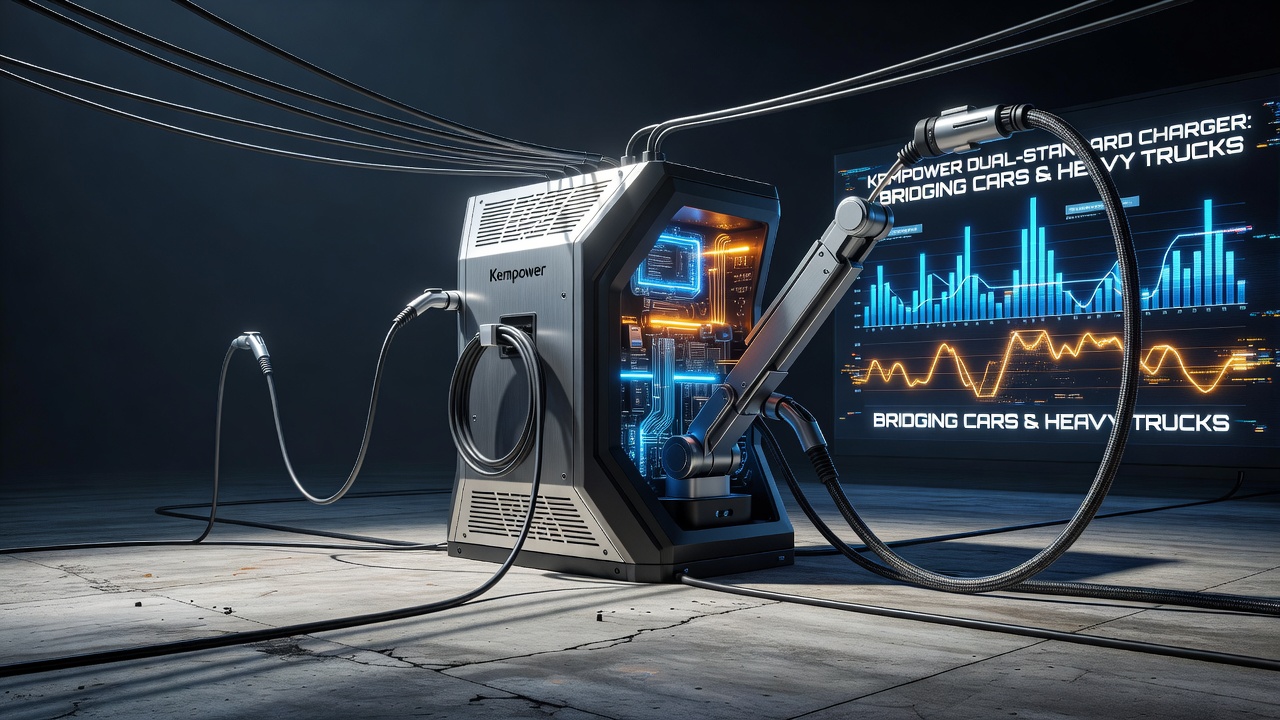
A single charging dispenser that can serve a passenger sedan in the morning and a fully loaded semi truck by afternoon is no longer a concept slide. Kempower has introduced the Mega Satellite Flex, a high-power charger capable of delivering up to 560 kW through the established CCS standard or up to 1.2 MW through the emerging Megawatt Charging System, marking the company's first product built to handle both standards at once.
The announcement lands at a pivotal moment for charging infrastructure. CCS remains the backbone of passenger EV charging worldwide, while MCS is only beginning to take shape as electric trucking scales up and demands power levels that ordinary chargers were never designed to provide. Fleet operators researching charging options today face many of the same compatibility questions that home users weigh when choosing a vpn for router setups built to serve multiple devices under one connection rather than juggling separate systems for each use case. vpn for router
By combining both standards into one unit, Kempower is betting that site owners will avoid the costlier path of building parallel infrastructure - one setup for cars, another for trucks - as the industry gradually shifts toward higher-voltage systems.
Why Two Standards on One Dispenser Matters
Charging networks have historically been built around a single use case, largely because passenger EVs and heavy-duty trucks have such different power requirements. Cars typically draw well under 350 kW even at fast-charging stations, while trucks hauling freight over long distances need power levels several times higher to make charging stops commercially viable. MCS was developed specifically to close that gap, but its rollout has been gradual, leaving operators uncertain about how quickly to invest in truck-specific hardware.
The Mega Satellite Flex sidesteps that uncertainty. A site can open with support for both vehicle classes from day one, then let usage patterns determine how the mix evolves. Kempower says the unit also accommodates newer 800-volt vehicle architectures, which are becoming more common among premium and performance-oriented EVs seeking shorter charging times.
Technical Specifications and Fleet Economics
The charger supports up to 1,500 amps on the MCS side and 700 amps for CCS, with cable lengths of 5 meters for CCS connections and 2.7 meters for MCS. An optional payment terminal allows the unit to serve public or mixed-fleet locations without additional hardware. It is also designed to integrate with Kempower's existing distributed charging architecture, meaning operators already running Kempower systems can add the Mega Satellite Flex without reconfiguring their entire site.
For operators, the underlying logic is financial as much as technical. A dispenser that serves both cars and trucks can achieve higher utilization rates than equipment built for a single vehicle type, which shortens the time needed to recover installation costs - a persistent challenge in an industry where charging hardware represents a significant upfront investment.
What Comes Next
Kempower revealed the Mega Satellite Flex at its Unplug & Recharge event held alongside ACT Expo, where the unit is currently on display. The company expects to bring it to market in North America and Europe in July 2026, giving fleet operators and charging network developers over a year to plan deployments around the new hardware. Whether MCS adoption accelerates fast enough to justify dual-standard installations at scale remains an open question, but Kempower's move signals a bet that the two charging worlds will need to coexist on the same pavement for years to come.